
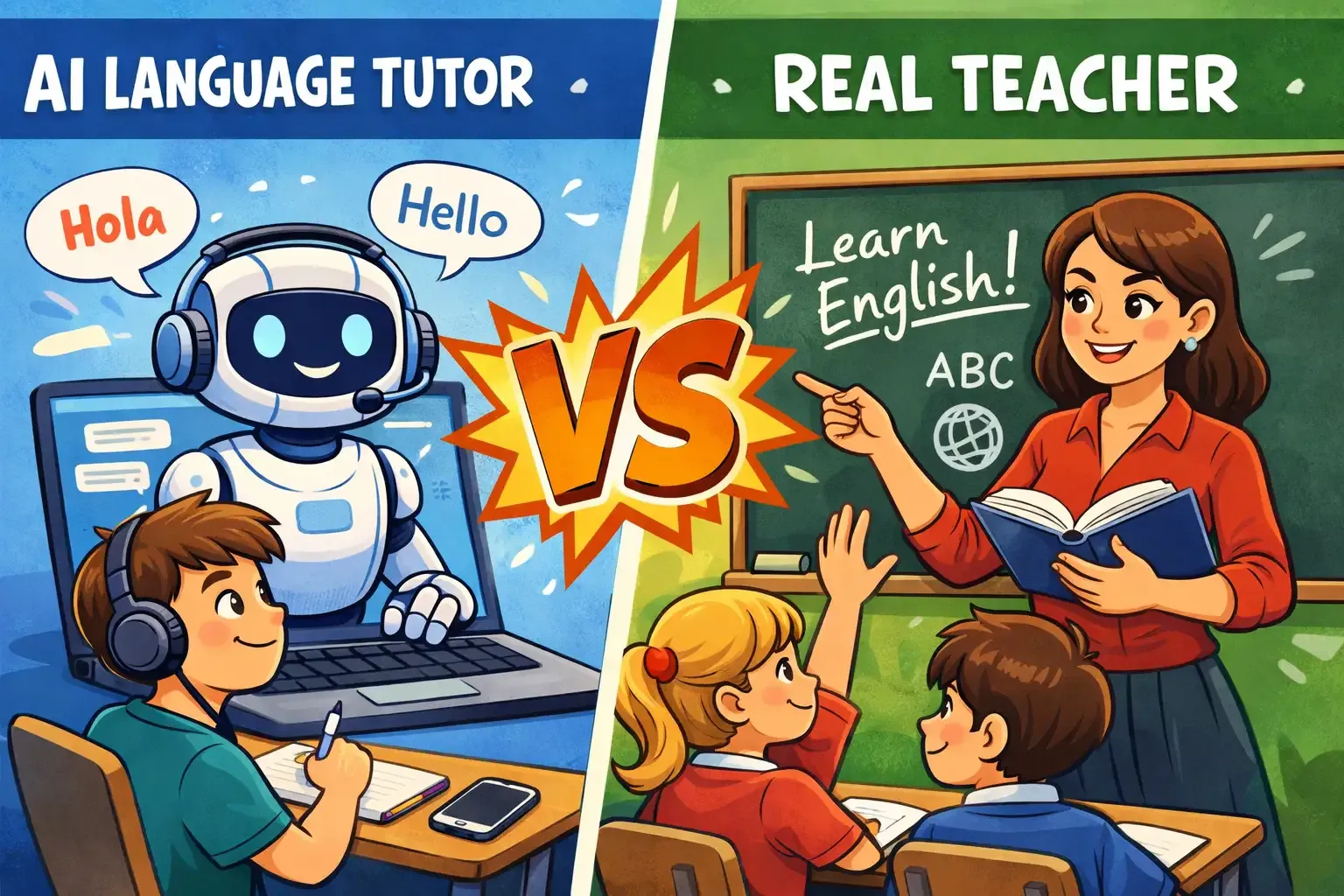
AI Language Tutor vs Real Teacher: An Honest Comparison (What Actually Works in 2025)
Discover the surprising truth about AI and human instruction—and why choosing just one might be holding you back.
Here's a question that's been buzzing around every language learning community lately: Can an AI tutor actually replace a real teacher?
If you've spent any time exploring language learning apps, you've probably noticed how sophisticated AI has become. Gone are the clunky chatbots that could barely string a sentence together. Today's AI language tutors can hold genuine conversations, correct your grammar in real time, and adapt to your exact skill level.
But does that mean your traditional language teacher is becoming obsolete? Not so fast.
We've done the research, looked at the latest studies, and gathered insights from language learners around the world. What we found might surprise you—and it could completely change how you approach your language learning journey.
The Rise of AI Language Tutors: What the Research Actually Shows
Let's start with the elephant in the room: AI tutors are getting seriously effective.
A landmark study at Harvard University found that students using an AI-powered tutor learned approximately twice as much in 20% less time compared to those in traditional active-learning classrooms. That's not a small improvement—it's a game-changer.
But here's what makes these results even more interesting: AI tutors seem particularly effective at reducing one of the biggest barriers to language learning—fear.
Research published in Nature found that AI-driven language tools improved learners' self-reflection, creativity, and emotional resilience while significantly reducing anxiety levels. One study showed a 19.25% improvement in speaking scores alongside dramatically reduced speaking anxiety.
Think about that for a moment. How many times have you known what to say in your target language but frozen up because you were afraid of making a mistake? AI removes that pressure entirely.
Where AI Tutors Truly Shine
Based on extensive research and real learner experiences, here's where AI genuinely outperforms traditional instruction:
1. Unlimited, Judgment-Free Practice
An AI tutor never sighs when you ask the same question for the fifth time. It never gets tired, frustrated, or impatient. You can stumble over pronunciation, make embarrassing grammar mistakes, and ask "silly" questions without any social consequences.
One learner in a recent study shared: "I used to hesitate to speak English, fearing I'd say something wrong. But with the AI platform's support, I felt safe to express myself. It really helped boost my confidence."
2. Available Whenever You Need It
It's 11 PM, you're winding down, and suddenly you have 10 minutes to practice. Good luck finding a human tutor available at that hour. AI tutors are ready 24/7, whether you want to practice during your morning coffee, lunch break, or late-night study session.
This flexibility isn't just convenient—it's transformative for busy people who struggle to commit to scheduled lessons.
3. Instant, Consistent Feedback
AI provides immediate corrections on pronunciation, grammar, and vocabulary. No waiting until your next lesson to find out you've been mispronouncing a word all week. The feedback is also consistent—you won't get different advice depending on your tutor's mood or teaching style.
A meta-analysis found that AI-powered speech recognition training produced medium to strong effects on improving pronunciation, with even stronger results when systems provided explicit corrective feedback.
4. Dramatically Lower Cost
Private human tutors typically charge between $30 to $150+ per hour. For the cost of a single session, you could have an entire month of unlimited AI conversation practice. This democratizes quality language instruction for learners who couldn't otherwise afford regular tutoring.
5. Data-Driven Personalization
AI tracks every interaction, building a detailed picture of your strengths, weaknesses, and progress. It adapts difficulty levels in real-time, ensuring you're always challenged but never overwhelmed. No human tutor can match this level of granular analysis across hundreds of practice sessions.
Where Human Teachers Remain Irreplaceable
Now for the other side of the story. Despite AI's impressive capabilities, research consistently shows there are things human teachers do that technology simply cannot replicate—at least not yet.
In a survey conducted by Lingoda, 85% of language learners recognized that human interaction remains essential to their learning journey.
1. Emotional Intelligence and Empathy
Human teachers can read subtle cues—a frustrated sigh, a confused look, the moment when confidence is starting to crack. They adjust not just what they teach, but how they teach based on your emotional state.
Many language tutors have been through the learning process themselves. They understand the frustration of forgetting a word you've learned a dozen times or the embarrassment of a cultural misunderstanding. AI hasn't lived that experience.
2. Cultural Nuance and Context
Language is more than grammar and vocabulary—it's culture, history, and human experience woven into words. A human teacher can explain why certain phrases are appropriate in one context but offensive in another, share personal anecdotes about cultural customs, and help you understand the unwritten rules of communication.
AI can analyze idioms and explain cultural differences to an extent, but some elements—humor that depends on timing or shared cultural memory, sensitive interactions that require lived experience—remain challenging for algorithms.
3. Real-World Conversational Spontaneity
Here's a crucial difference: conversations with AI tend to be somewhat predictable. You can take your time, pause to think, even walk away for a coffee and come back. The AI will wait patiently.
Real humans don't work that way. They interrupt, change topics unexpectedly, use slang, speak over each other, and require you to think on your feet. If you only practice with AI, you might freeze up when you need to order that coffee in Paris or negotiate at a market in Barcelona.
4. Mentorship and Inspiration
Teachers do more than transfer information—they inspire. Many learners can point to a specific teacher who believed in them, pushed them through difficult periods, or sparked their love for a language. This mentorship creates motivation that no algorithm can manufacture.
5. Accountability and Structure
Let's be honest: it's easy to skip a session with an AI tutor. There's always tomorrow, right? Human teachers create external accountability. Knowing someone is waiting for you, expecting progress, and invested in your success provides motivation that keeps many learners on track.
The Surprising Truth: It's Not Either/Or
Here's what the research consistently points to: the most effective approach combines both AI and human instruction.
Think of it like this: AI handles the high-frequency repetitive practice—drilling vocabulary, correcting pronunciation, providing endless conversation practice without judgment. Human teachers focus on the higher-order skills—fostering creativity, guiding deeper discussions, providing cultural insight, and offering the emotional support that keeps you going.
A practical recommendation from language learning researchers: use an AI tutor daily for 10 to 20 minutes of pronunciation, vocabulary, and targeted grammar drills. Then add one or two human-led sessions per week for live conversation, role-play, and feedback on tone and nuance.
This hybrid model isn't just more effective—it's also more sustainable for most learners. You get the consistency and accessibility of AI with the depth and human connection of real teachers.
How to Make the Right Choice for Your Learning Journey
So how do you decide what balance works for you? Ask yourself these questions:
What's your biggest barrier right now? If it's fear of speaking or lack of practice time, AI might be exactly what you need to break through. If it's understanding cultural context or maintaining motivation, a human teacher could be more valuable.
What's your budget? If private tutoring isn't financially feasible, AI provides an incredible alternative that can take you surprisingly far. You might find that even occasional human sessions combined with daily AI practice gives you the best of both worlds.
What's your learning style? Some people thrive with the independence and flexibility of AI. Others need the accountability and personal connection of human instruction. There's no wrong answer—just honest self-assessment.
Where are you in your journey? Research suggests that lower-proficiency learners often benefit more from AI interaction, while advanced learners may need human teachers to refine nuanced communication skills.
The Bottom Line: Technology Amplifies, Humans Inspire
The debate between AI tutors and human teachers often misses the point. It's not about which one is "better"—it's about understanding what each offers and using them strategically.
AI removes financial, geographic, and psychological barriers to practice. It gives you unlimited opportunities to make mistakes safely, get instant feedback, and build foundational skills at your own pace. For many learners, especially those who've been held back by fear or lack of access, this is transformative.
Human teachers provide depth, empathy, cultural richness, and the kind of inspiration that turns language learning from a task into a passion. They see you as a person, not a data point, and that matters enormously.
The future of language learning isn't about choosing sides. It's about recognizing that technology can multiply your practice time and efficiency, while human connection gives that practice meaning and direction.
Whether you use AI, human teachers, or both, the most important thing is that you keep practicing. Every conversation, every mistake, every small victory brings you closer to fluency.
And honestly? There's never been a better time to learn a language. You have tools at your fingertips that previous generations couldn't have imagined. The only question is: how will you use them?
Ready to Experience the Best of AI Language Learning?
Erla's Chat Mode gives you unlimited AI conversation practice across 12 engaging topics—without the fear of judgment. Get personalized feedback, grammar corrections, and vocabulary building, all adapted to your level. Combined with our Listening and Reading modes, you'll build real comprehension skills through context, not memorization.
Start practicing today with just 5-10 minutes a day. Download Erla and discover why thousands of learners are finally making progress they can feel.