Learn a Language by Listening — Train Your Ear with Real Speech
Hear a native-pace sentence, try to catch it, then tap to reveal the text. Translation and grammar are one tap away when you want them. Five to ten minutes a day is enough.
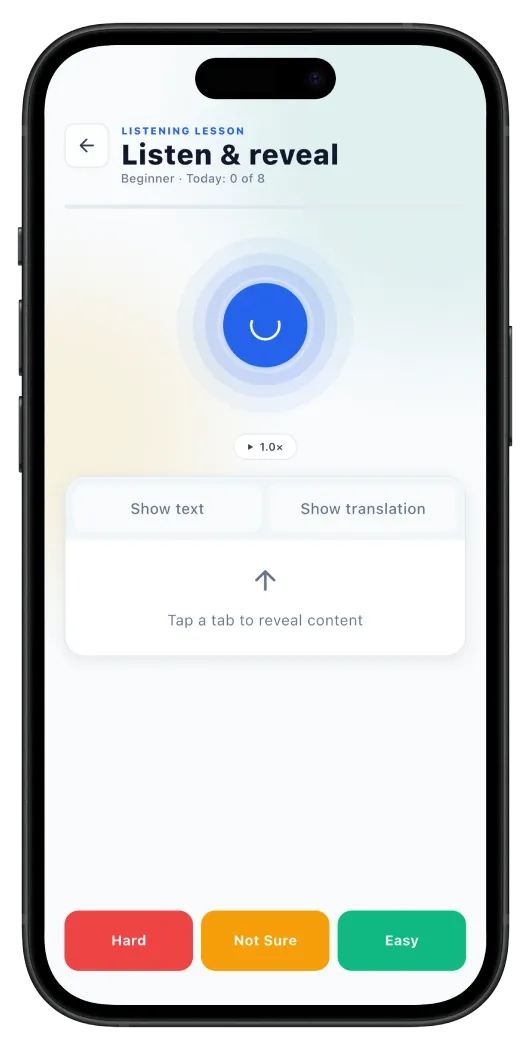
Listening is how you learned the first language. It works again.
You can learn a language by listening — not by drilling flashcards, but by hearing real sentences at native pace and slowly training your ear to catch them. That is the idea behind Listening Mode in Erla. A short audio clip plays. The text below stays blurred. You listen, you guess, and only then do you tap to see how close you got.
It does not feel like a worksheet. It feels like a real moment of comprehension — the kind that builds when a phrase you have heard three times finally clicks. That is listening comprehension built sentence by sentence: how natives stress vowels, where they swallow consonants, when their voice rises and falls. Patterns no flashcard could teach you.
This is how children acquire their first language, and the same approach research calls comprehensible input. Erla wraps it around the four other modes — Reading, Watch, Chat, and Talk — so listening is the entry point, not the only one. Open the app on the train, on the couch, between meetings. Five to ten minutes a day is enough.
How a listening task works
Five steps. About thirty seconds each. Repeat as often as you like.
- 1
A native-quality voice plays a real sentence
Audio plays automatically when the task opens. The voice is AI-generated but tuned to sound natural — proper pauses, real intonation, accents drawn from where the language is actually spoken. No robotic flatness.
- 2
The text is blurred — you try to catch it by ear
Below the audio the sentence sits visibly blurred. Your only tool is what you just heard. Replay as many times as you need. Switch to 0.75× speed if it is coming in too fast. The blur is on purpose — peeking before you have tried short-circuits the work.
- 3
Tap to reveal the text and check what you got
When you are ready, tap. The blur clears and the sentence appears. Compare what you heard to what was actually said. Most learners are surprised how close they were after a few days.
- 4
Open translation and grammar for anything you missed
Tap any sentence for a full translation in your native language and a grammar breakdown — verb tense, word order, why this article and not the other one. There when you want it, invisible when you do not.
- 5
Rate it Easy, Not Sure, or Hard — Erla spaces it back
Every task ends with three buttons. Tap Easy and the sentence drifts further out. Tap Hard and it comes back sooner, in slightly different forms. That is the spaced repetition engine — recognition is not the same as remembering.
Why you can learn a language by listening
Three reasons the method works on adult brains, not just children.
It is how you learned the first one
No baby held a flashcard. By the time a child speaks a first word, they have heard about four thousand hours of speech in context. Erla shortens the loop — clear, level-matched sentences instead of noise — but the mechanism is the same.
Pronunciation rides along for free
Hear a word before you see it written and your brain encodes the sound first, spelling second. Adults who learned 'salmon' from a page often mispronounce it; kids who heard it never do. Your accent improves before you consciously practise speaking.
Reading and speaking get easier
Once your ear knows how a sentence sounds, reading it feels natural — you hear it in your head. Same with speaking: you do not invent intonation if you have already absorbed it. Listening Mode is the foundation the other modes lean on.
Practice without carving out time
Listening tasks slot into moments you already have.
On the commute
Headphones in, eyes closed. One listening task is about thirty seconds. Twelve of them fits inside a podcast intro.
Walking the dog
No screen, no scrolling. Play the audio, guess, walk a few steps, tap to reveal. Mutter Spanish under your breath, the dog will not mind.
Cooking dinner
Hands sticky, brain free. Prop the phone on the counter, play a sentence between stirring. Listening Mode never asks you to type.
In line for coffee
Three minutes is three sentences, a streak update, and a slightly stronger ear by the time the barista calls your name.
At the gym
Between sets, audio in. Treat each listening task like a recovery rep — short, focused, never overwhelming.
Before bed
The phone is already in your hand. Skip a swipe, open Erla, finish the day with one sentence you actually understood.
What is inside every listening task
Small details that matter when the audio gets hard.
Native-quality AI voices
AI listening practice that does not sound like AI — natural pace, real intonation, the kind of voice you would actually hear in a film.
1.0× and 0.75× playback
Slow it down when the consonants run together. Bring it back up when you are ready. The setting persists across sessions.
Translation in your language
On tap, in whichever native language you set in onboarding. Cached locally so the second tap is instant.
Grammar for every sentence
Why this tense, this word order, this article. Specific to the sentence — not a generic chapter.
Difficulty rating
Easy, Not Sure, Hard. Tells the spaced-repetition engine whether to bring this sentence back tomorrow or in three weeks.
Free, no PRO required
Listening Mode is in the free tier. Reading too. No daily limit and no paywall on either.
Yes, you will miss things — that is the point
The first time you listen to a sentence in a new language, you will catch maybe one word in five. That feels uncomfortable. It is also the cognitive state researchers call comprehensible input — the productive zone where the brain stretches to fill the gaps. Comfortable equals not learning.
Erla is built around that discomfort, not against it. The audio does not stop, the blur does not peek. After a week the gap shrinks. After a month it shrinks again. That is how you go from 'sounds like noise' to 'sounds like a language' — slowly, then suddenly.
Listening Mode — FAQ
Short answers to what people ask before they download.
Yes — most of what fluent speakers know, they learned by listening. Erla applies that to adults: hear native-pace audio, try to catch the meaning, then reveal the text and check what you got. Tap for translation and grammar when you want them. Five to ten minutes a day for a few weeks and the gap shrinks fast.
Pairs well with the other four modes
Listening is the entry point. The others build on the ear it gives you.
Reading Mode
Short stories with sentence-level translation and grammar. Free, like Listening.
Watch Mode
Short videos play without subtitles first, then reveal the text. PRO.
Chat Mode
Text conversations with an AI tutor who adapts to your level and gives grammar feedback. PRO.
Talk Mode
Voice conversations with an AI tutor — real-time pronunciation feedback. PRO.
Train your ear today
Listening Mode is free, available on iOS and Android. Five minutes from now you will have heard your first native-pace sentence in a new language.