Learn a Language by Reading — Real Stories, Native Audio, Grammar on Tap
Read short stories written at your level, with native read-along audio that highlights each sentence as it is spoken. Tap any line for a translation and a grammar breakdown. Five to ten minutes a day, finished in one coffee.
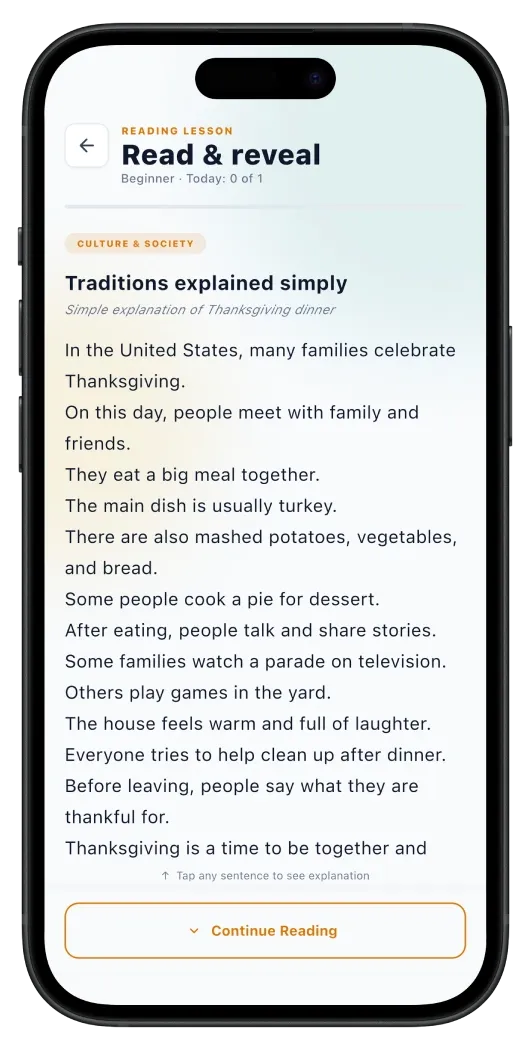
Reading is the fastest channel into a new language. Erla makes it work.
You can learn a language by reading — not by squinting through novels you are not ready for, but by reading short, level-matched stories where every word you do not know is one tap away. That is the idea behind Reading Mode in Erla. A story opens. You read at your own pace. The moment a sentence stops making sense, you tap it and the translation, the grammar, the word-by-word breakdown all appear.
Most reading apps for learners stop there. Erla goes one step further: tap Play and a native voice reads the story aloud, with the sentence currently being spoken gently highlighted as the audio moves. You see the line, you hear the line, your eye and ear lock onto the same pattern. That is the bridge silent reading has always been missing — the reason your reading vocabulary has historically run ahead of what you can say out loud.
It is built for adults with full lives. Open the app at lunch, on a flight, in bed. Stories run a few minutes. Each one finished is three points toward the day's goal, and a small comprehension score that climbs as you stop needing the tap. Five to ten minutes a day, every day, is enough.
How a reading session works
Five steps. A few minutes per story. Read silent, read aloud, or both.
- 1
Open a story matched to your level
Erla picks the next story for you, graded to your current level — Beginner, Intermediate, or Advanced. Beginner stories use simple sentences and common words. Advanced ones bring real syntax and richer vocabulary. You can change level any time.
- 2
Read at your own pace
The story sits on the screen as plain, clean text. No quiz between sentences, no popup interrupting the flow. Read fast, read slow, scroll back. The clock is not running.
- 3
Tap Play to hear the story read aloud
A native-quality voice reads the full story. The sentence being spoken is gently highlighted in amber, and the page auto-scrolls to keep that line in view. Switch to 0.75× speed when a phrase runs too fast. Tap pause whenever you want to think.
- 4
Tap any sentence for translation and grammar
Any sentence, at any time. A panel slides up with a full translation in your native language, a word-by-word breakdown, and a grammar note explaining why this tense, this article, this word order. Audio quietly pauses; close the panel and it picks back up exactly where it left off.
- 5
Finish the story — three points and a score
Reading Mode is worth three points per finished story, the highest of any mode in Erla. Each completion also nudges your understanding score, the rolling average of the last hundred lessons. Both feed your daily goal and your five-day streak.
Why you can learn a language by reading
Three reasons it works on adult brains, even faster than on children's.
Vocabulary sticks in context, not on flashcards
A new word learned inside a story carries a scene, a character, a sentence around it — those hooks are what your brain actually files the word under. Flashcards strip the hooks away and ask your brain to remember a naked pair. Reading puts the hooks back.
Grammar absorbs through pattern, not through rules
You did not learn your first language by memorizing tense tables. You saw a structure used over and over, in different sentences, and at some point you noticed the pattern. Stories do that for the second language too — Erla just adds an on-demand explanation for the sentences where the pattern does not click.
Read-along audio fixes the silent-reading gap
Adults who learn from a page often mispronounce words they have read for years. Reading Mode plays the story aloud with the spoken sentence highlighted, so the sound and the spelling encode together. Your reading vocabulary stops being trapped on the page.
Quiet moments are reading moments
A short story fits where audio or video would not.
On a lunch break
Twenty minutes is one story, slowly, with every sentence tapped. Or three short stories at pace. Either way the day gets a small win before the inbox catches up.
Before bed
Reading winds the brain down. A short story in your target language is a softer landing than a feed, and you will remember tomorrow what you read.
On a flight
Download stories before takeoff and Reading Mode works fully offline. No Wi-Fi, no signal — just text, translation, and tap-to-explain. The audio caches too.
In a waiting room
Doctor's office, school pickup, the queue at the post office. A reading task does not need headphones, does not make noise, and ends cleanly whenever you are called.
Between meetings
Fifteen minutes between calls is one story and a streak update. Glance through, tap two words you missed, close the app, take the next meeting in your other language.
Weekend coffee
The longer reading session. Pour a coffee, tap Play, follow the highlighted line, finish two or three stories with the audio on. The week's biggest jump usually happens here.
What is inside every story
Small details that matter when the sentence gets hard.
Native story audio with sentence highlighting
Tap Play and the full story reads aloud. The current sentence highlights in amber and the page auto-scrolls so the line stays in view.
1.0× and 0.75× playback
Slow it down when the consonants run together; bring it back up when your ear catches up. The setting persists across stories and across modes.
Tap any sentence for translation and grammar
Translation in your native language, a word-by-word breakdown, and a grammar note about this exact sentence. Cached locally, instant on the second tap.
Stories graded to your level
Beginner uses common words and short sentences. Intermediate brings varied topics. Advanced uses complex syntax and richer vocabulary. Switch any time in Settings.
Real content variety
Fairy tales, daily-life scenes, interesting facts, short fiction across many topics. Not the same five sentences in a different order.
Free, no PRO required
Reading Mode is fully free. No daily limit, no paywall, no ads. Listening Mode is free too — Watch, Chat, and Talk unlock with PRO.
Yes, you will meet words you do not know — that is how it works
The first story in a new language will have sentences where every other word is a tap. That can feel like failure. It is not — it is the cognitive state researchers call comprehensible input, the productive zone where the brain stretches to fill the gaps. Comfortable reading means the level is too low and nothing new is going in.
Reading Mode is built around that stretch, not against it. Stories sit just above your level, the taps are frictionless, the translation never makes you leave the page. After a week the gap shrinks. After a month, you finish a story without tapping anything at all — and then Erla quietly bumps you up to the next level.
Reading Mode — FAQ
Short answers to what people ask before they download.
Yes — for adults, reading is one of the fastest channels into a new language because vocabulary sticks better when it arrives inside a sentence than on a flashcard. Erla's Reading Mode is built so you can read stories to learn a language without a dictionary at your elbow: short, level-graded stories with translation and grammar one tap away, and native read-along audio that highlights the sentence being spoken. Five to ten minutes a day for a few weeks and the gap between what you can read and what you can understand on the fly closes fast.
Pairs well with the other four modes
Reading sets the patterns. The others work the same patterns from different angles.
Listening Mode
Audio-first sentences with a reveal. The natural partner to Reading — and also free.
Watch Mode
Short videos play silent first, then reveal the text. Swipe like a feed. PRO.
Chat Mode
Text conversations with an AI tutor who adapts to your level and gives grammar feedback. PRO.
Talk Mode
Voice conversations with an AI tutor — real-time pronunciation feedback. PRO.
Read your first story today
Reading Mode is free, available on iOS and Android. Five minutes from now you will have read your first story in a new language — and heard it read aloud, sentence by sentence.