
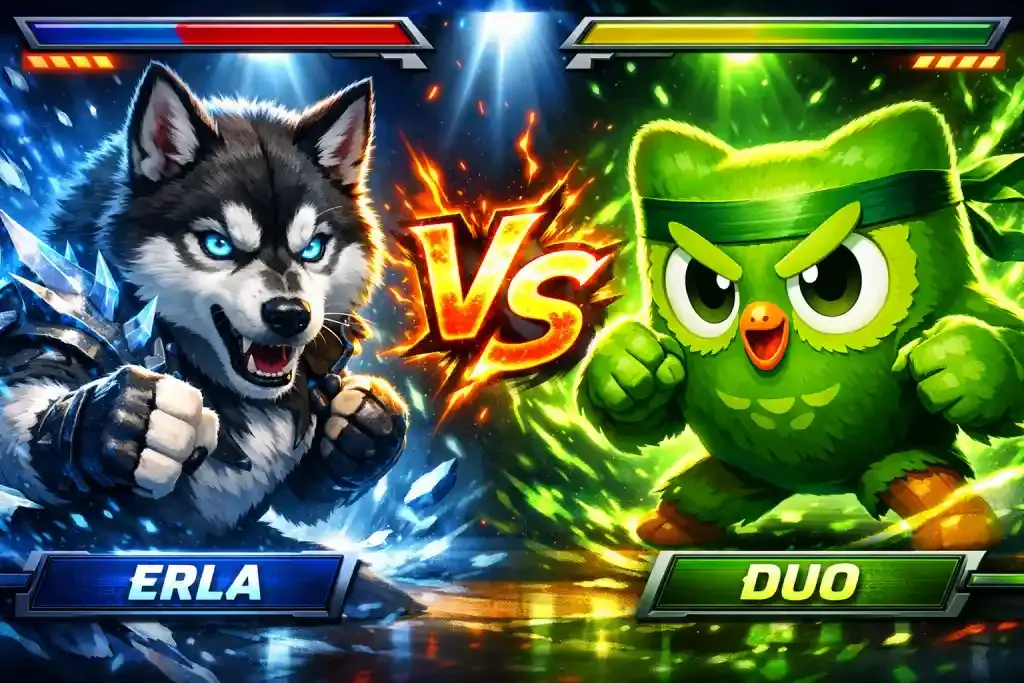
Best Free Duolingo Alternative in 2026: Comprehension-First Language Learning
One gamifies vocabulary. The other builds comprehension. Here's what that actually means for your learning.
Let's get something out of the way: Duolingo is an impressive product. Over 500 million downloads, a beloved owl mascot, and they've genuinely made language learning more accessible to millions of people. That matters.
But here's a question worth asking: Is the way Duolingo teaches how languages are actually learned?
We built Erla because we believe the answer is no. Not because Duolingo is bad — but because we think there's a better approach for people who want to actually understand a language, not just collect points.
The Core Difference: Gamification vs Comprehension
Duolingo's genius is turning language learning into a game. Streaks, XP, leaderboards, hearts — it's designed to keep you coming back. And it works. The app is sticky.
But there's a catch. When learning becomes a game, the goal shifts from understanding to winning. You start optimizing for points, not comprehension. You grind flashcards to maintain your streak, even when you've stopped actually absorbing anything.
Erla takes a different approach entirely. We're built on what linguists call comprehensible input — the idea that humans acquire language by understanding messages, not by memorizing vocabulary in isolation.
Think about how children learn their first language. No flashcards. No grammar drills. They listen, absorb context, and gradually piece together meaning. That's the model we follow.
How Each App Actually Works
Duolingo's Approach
Duolingo teaches through translation exercises and pattern matching. You see a word, match it to a picture, translate sentences back and forth. The app builds your vocabulary through repetition and tests your recall.
It's effective for memorization. After a few weeks, you'll recognize individual words. You can translate simple sentences. You know that "Hund" means "dog" in German.
But here's what often happens: you encounter real German — a podcast, a conversation, a movie — and you're lost. The words come too fast. The context is different. You've learned about the language, but you haven't developed the ability to understand it.
Erla's Approach
Erla trains your comprehension first. Our Listening Mode plays native speaker audio in real-life scenarios. You hear a phrase, guess what it means, then reveal the text and translation. You're training your ear from day one.
Our Reading Mode works similarly — interactive stories where you tap any sentence to see its structure and meaning. You learn vocabulary through context, not isolation. You see how words actually work together.
The philosophy is simple: understanding is everything. If you don't understand, you won't speak. You won't write. Comprehension comes first — production follows naturally.
What the Research Says
This isn't just our opinion. Decades of second language acquisition research support comprehension-first approaches. Stephen Krashen's Input Hypothesis, widely regarded as foundational to the field, argues that we acquire language when we understand messages — not when we consciously memorize rules or vocabulary.
Studies on adult language learners consistently show that extensive listening and reading lead to better outcomes than grammar-translation methods. The brain needs input it can process, not just exercises to complete.
An Honest Feature Comparison
Duolingo strengths:
- Massive course library (40+ languages)
- Highly polished, game-like experience
- Strong community features
- Great for absolute beginners who need motivation
- Structured curriculum with clear progression
Erla strengths:
- Comprehension-first methodology
- Native speaker audio in realistic contexts
- 22 languages with authentic content
- No gamification pressure — learn at your pace
- Interactive stories that teach vocabulary in context
- Designed for busy people (5-10 minutes daily)
Where Duolingo wins: If you need gamification to stay motivated, if you're just dabbling for fun, or if you want a language Erla doesn't support yet — Duolingo is a solid choice.
Where Erla wins: If you actually want to understand spoken language, if you're frustrated with "knowing words but not getting conversations," or if you want to learn the way humans naturally acquire language — Erla is built for you.
The Streak Problem
Here's something we think about a lot: Duolingo's streak feature is brilliant for engagement. But it can also make you feel like a failure when you miss a day, or worse — make you grind through lessons just to keep a number alive.
Language learning isn't about perfect attendance. It's about quality exposure over time. Missing a day doesn't reset your brain. Your German doesn't evaporate because you skipped Tuesday.
We deliberately left streaks and leaderboards out of Erla. Not because they're evil — but because we want you focused on understanding, not competing.
Who Should Use What?
Choose Duolingo if:
- You're a complete beginner who needs motivation to start
- You enjoy gamification and competition
- You're learning casually without specific goals
- You want a language Erla doesn't support
Choose Erla if:
- You want to understand spoken language, not just recognize words
- You've used other apps and still can't follow real conversations
- You prefer learning through listening and reading, not drills
- You want to learn naturally, without gamification pressure
- You're serious about actually acquiring the language
Use both if: You want Duolingo for structured vocabulary building and Erla for training your ear and reading comprehension. They can complement each other.
The Bottom Line
Duolingo and Erla aren't really competitors — we're solving different problems. Duolingo asks: How do we get people to practice every day? Erla asks: How do we help people actually understand?
Both questions matter. But if you've ever felt the frustration of knowing vocabulary without understanding conversations, of translating in your head instead of just getting it — that's the gap we built Erla to close.
Comprehension comes first. Everything else follows.
Ready to try a different approach? Download Erla and see how comprehension-first learning feels.