A Vocabulary Practice App That Turns Saved Words Into Words You Know
Erla practices the words you saved with three escalating formats — recognise it, pick it out, then spell it from scrambled letters. Active recall, spaced a day apart, until each word is truly yours.
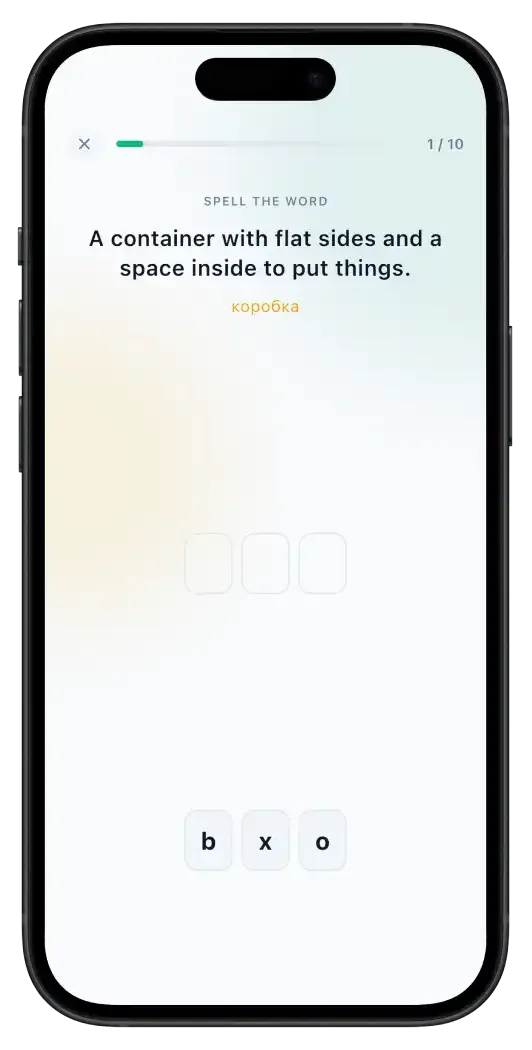
Saving a word is easy — Erla's vocabulary practice app makes it stick.
Collecting words is the easy part. Turning them into vocabulary you can actually use — recall on the spot, spell without looking — is the work most apps skip. Erla's word practice does exactly that work, using only the words you saved to your wallet from real lessons.
You practice vocabulary in short sessions of ten due words. Each word moves through three formats that get harder as you improve: first you simply recognise it, then you pick it out from look-alikes, and finally you spell it from a jumble of letters. Get one wrong and it drops back to the start — there's no shortcut to 'done'.
There are no decks to build and no cards to flip and self-grade. Because every word came from content you already understood, practice is active recall, not cold memorisation — the difference between a word you've seen and a word you own.
How a practice session works
Ten words, three formats, a day's spacing between reviews.
- 1
Save at least ten words first
Practice unlocks once your wallet holds ten or more words still being learned. It needs a real pool to draw from, so the multiple-choice options are always other words you actually know.
- 2
Start a session of ten due words
Each session serves exactly ten words that are due — ones you haven't seen in at least a day. Words you reviewed yesterday wait their turn, so you're never drilling the same word twice in one sitting.
- 3
Stage 1 — recognise it
A word appears with audio. Tap 'I know it' or 'Not sure'. Either way you see the explanation and meanings; the difference is just how long you linger to study before the word advances.
- 4
Stage 2 — pick it out
Now you see only the explanation and meanings, and choose the right word from three options — the answer plus two real words pulled from your own wallet. Choose wrong and the word resets to the start.
- 5
Stage 3 — spell it
Finally, build the word from a jumble of its own letters, with the explanation as your only prompt. Spell it correctly and the word graduates to Done. Miss it and it drops back to stage one.
Why three formats beat flip-and-forget
Recognition, recall, and production — in that order, on purpose.
Active recall, not passive review
Flashcards let you glance, flip, and tell yourself you knew it. Erla makes you produce the answer — choose it, then spell it — which is the effortful retrieval that actually moves a word into long-term memory.
Difficulty that climbs with you
A word you just met shouldn't be a spelling test, and a word you nearly own shouldn't be a freebie. The three stages match the challenge to where each word is, so practice is never too easy or too punishing.
Spacing built in
Each word rests at least a day between reviews — the simple spacing that helps memory consolidate. You meet a word, leave it, and come back; the gap is where the learning quietly sets.
When word practice fits
Short sessions that turn idle minutes into real vocabulary.
The five-minute warm-up
Open a session before your first lesson. Ten words, a couple of minutes, and your saved vocabulary is warm before you read or listen.
Clearing the backlog
Saved a burst of words from a binge of stories? Practice chips them down from 'seen once' to 'done', a session at a time.
The word that won't stick
Some words reset again and again. That's the system working — it keeps the stubborn ones in rotation until they finally hold.
Commute-sized review
A session fits a bus stop or a coffee queue. No typing essays — it plays more like quick vocabulary practice games than homework: recognise, choose, spell, done.
Before you sleep
A quiet ten-word session is a calmer way to end the day than a feed — and the overnight gap is exactly the spacing your memory wants.
Proving you actually know them
The Done tab is honest: a word only lands there after you've spelled it unaided. It's a real record of vocabulary you can use, not just words you've seen.
What's inside a practice session
The details that keep practice honest and quick.
Ten due words
Every session is exactly ten words that are ready for review — never a wall of hundreds at once.
Three escalating formats
Recognition, multiple choice, and letter-scramble spelling, matched to each word's current stage.
Distractors from your own words
Multiple-choice options are real words from your wallet, so wrong answers are plausible, not silly.
Reset on a miss
Get a word wrong at any stage and it drops to the start — mastery has to be earned, not guessed.
A clear progress indicator
Three dots per word show how far it's come, from just-saved to nearly done.
An end-of-session summary
After the tenth word, see which words advanced and which reset, so you know what's coming next time.
It asks for a little patience — that's the point
Erla won't tell you a word is learned after one tap. A word only reaches Done once you've recognised it, chosen it among look-alikes, and spelled it from scratch — on separate days. That's slower than a flashcard you swipe through in seconds, and it's meant to be.
Two honest notes. You need at least ten saved words before practice unlocks, because the multiple-choice rounds pull from your own vocabulary — fewer words would make the options too easy to guess. And practice is spaced: if nothing is due yet, Erla asks you to come back tomorrow rather than drill words your memory hasn't had time to forget.
Word Practice — FAQ
Short answers to what people ask before their first session.
It's the part of Erla that turns the words you saved into words you know. Each saved word is practiced through three formats — recognition, multiple choice, then spelling from scrambled letters — until you can produce it from memory. You only ever practice words you collected yourself.
Fills from everything you practice
Practice runs on the words you save across Erla's modes.
Vocabulary Wallet
Where it starts — save words from any lesson with one tap, then send them here to practice.
Reading Mode
Meet new words in short stories, save the keepers, and practice them into memory later.
Listening Mode
Train your ear at native pace, then drill the words you caught until they hold.
Chat Mode
Pull words from your AI tutor's replies and turn them into active vocabulary.
Turn your saved words into words you know
Pick your language and start practicing. Erla is free on iOS and Android, in 22 languages — recognise, choose, and spell your way from a wallet full of words to vocabulary you can actually use.